

 All TVs
 All Audio
 All Refrigerators
 All Washing Machines
 All Air purifies
The Difference Between UHD and OLED TVs: Which Is Best for You?

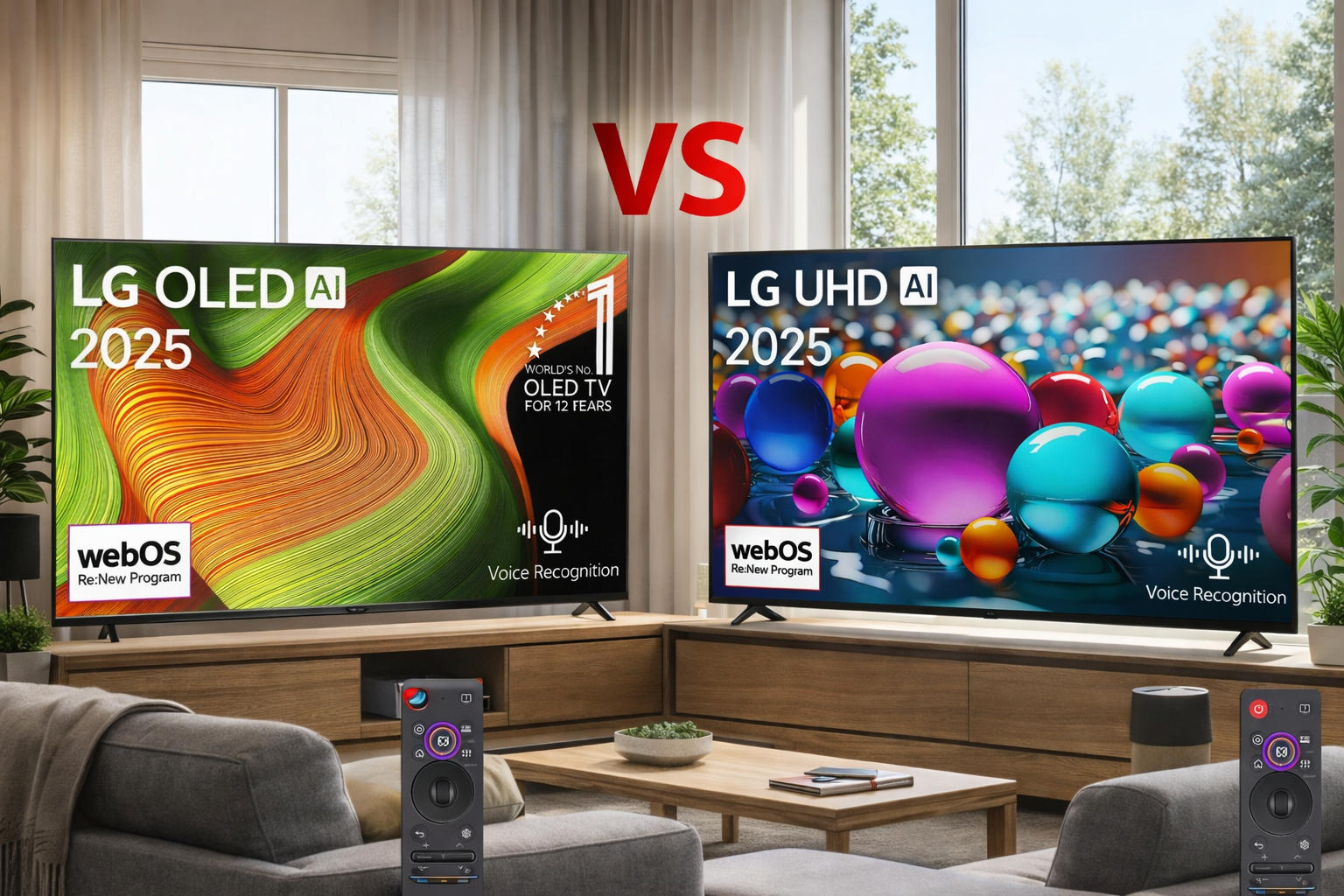
Are you searching for a new TV? Then you probably came across unfamiliar yet key terms that are essential to choosing the right type of TV for your needs. Therefore, it is important to understand the difference between UHD and OLED TVs, allowing you to shop smartly for your home. Want an immersive watching experience? This guide will help you make the right choice for entertainment like never before.
Is OLED better than UHD? Or is it the other way around? Continue reading to learn more about OLED TVs and UHD TVs, what these technologies offer, and which is best for you according to your usage and preferences. No matter which option you go with, rest assured that your favorite movies, sports, music, and games will look exceptionally realistic and feel incredibly engaging beyond expectations.
What is a UHD Screen? How It Applies to TVs
A UHD screen is one of the top options for those wanting to take home entertainment to the next level. A UHD (Ultra High Definition) screen is a display that has a very high resolution—specifically 3840 × 2160 pixels, which is four times the number of pixels found in standard Full HD screens.
You may be thinking: What do pixels have to do with any of this? And what are they to begin with? Pixels are the smallest unit of a digital image or display, and they function like little dots making up the bigger picture. With a higher pixel count, you get a clearer, sharper, and more detailed image, which is the case with UHD screens.
UHD on TV
What does UHD mean in a TV? A UHD TV is a high-resolution TV, meaning that you get to enjoy crisp, detailed, and clear images even on large screens or when sitting closer to the screen. This technology ensures that you are fully immersed in the fictional realities you are streaming and playing in, elevating your entertainment experience with thrill and awe.
The clarity provided by UHD technology immerses you in the action of any sports event, allowing you to experience the excitement as if you were there, all from the comfort of your own home. Say goodbye to blurry and pixelated images and texts with UHD TVs, the best option for seamless displays, rich with stunning details and breathtaking picture quality.
Before exploring the difference between UHD and OLED TVs, below is a brief overview of OLED screens.
What is an OLED Screen? How It Applies to TVs
OLED screens are an excellent choice for anyone looking to enjoy entertainment to the fullest. An OLED screen uses organic, carbon-based compounds that send out light when an electric current passes through them. As a result, OLED screens generate their own light, unlike other, more traditional models that rely on a backlight shining through the pixels.
This self-emitting design results in a more refined and immersive viewing experience as it controls brightness and color with greater precision. So, the images appear more balanced, visually engaging, and closer to what the content was intended to look like.
OLED on TV
OLED TVs deliver vivid, dynamic, and rich colors thanks to how they operate. As each pixel emits its own light, the screen can control the brightness of each red, green, and blue subpixel with great precision, blending them to create lifelike colors. At the same time, blacks appear truly deep on OLED TVs because the pixels meant to display black receive no current and emit no light, showing perfect, rich blacks and enhanced contrast. With the bright colors appearing so striking and the dark ones extremely deep, the contrast is immersive and stunning no matter the type of content on the screen.
Now that you know how UHD and OLED screens work, it is time to differentiate between them more distinctly. Learning the difference between UHD and OLED TVs is key to buying the right option, so here are some major differences you should keep in mind when shopping.
UHD vs OLED: Which Is Better? UHD TV vs OLED Comparison
Before getting into the differences between UHD and OLED TVs, it is worth mentioning that both are excellent options and incredible additions to your home. However, you can get the most out of your entertainment experience by purchasing the type of TV that best fits your watching preferences, viewing environment, and budget.
Below is a breakdown of the differences between UHD and OLED TVs that will help you with the selection process:
Detail vs. Depth
Since UHD TVs feature about 8.3 million pixels in total, they deliver very realistic displays with smooth lines, refined textures, and lifelike details. Wondering what this will look like for you as the viewer? Faces look more natural, fabrics show subtle patterns, and beautiful sceneries such as city skylines and natural landscapes appear more authentic and breathtaking.
So, you can notice the subtleties in movies and watch them as they were intended to be experienced. If you are a gamer, you would easily spot distant objects, textures on buildings, or intricate armor details on characters, which would look softer or blended on lower-resolution screens. With UHD TVs, subtitles and on-screen text are sharp, and user interfaces are clean and easy to read, making your overall experience a lot easier and more comfortable.
On the other hand, OLED TVs are more about depth rather than detail. They create perfectly deep blacks and vibrant, bright colors, resulting in striking high contrast. At the same time, colors do not bleed into each other since each pixel lights up independently without a backlight. This means blacks are not affected by light from nearby bright areas, and bright colors are not darkened by adjacent dark areas.
With OLED TVs, all dark scenes are truly black, making night shots and shadowy settings feel immersive and realistic—a plus for horror movie enthusiasts and gamers. Bright colors pop vividly, capturing your attention and curiosity but without them affecting nearby darker colors. Such contrast offers a three-dimensional feel that makes all content highly engaging and beautifully appealing.
Viewing Angles
One of the key differences between UHD and OLED TVs lies in viewing angles and how they affect your watching experience. In UHD TVs that use the LED/LCD technology, each pixel contains liquid crystal cells placed between glass layers. These crystals do not generate light on their own. Instead, a backlight shines through them, and each crystal twists or blocks the light differently to produce varied levels of brightness and different colors. Now, what does that have to do with viewing angles?
Since the light comes from behind and passes through the glass layers, the images look best and sharpest when viewed straight on. But when viewed from the side, the colors are altered as the blacks appear lighter and the colors less dynamic due to how the light travels. Therefore, there is a drop in the overall contrast, clarity, and vibrancy.
To counter this effect, some UHD screens incorporate IPS panels, which are a technology that aligns the liquid crystals horizontally, allowing light to pass more evenly through the pixels. This results in more consistent colors and contrast when viewed from the side, but it does not entirely eliminate the occurring shifts in the picture quality.
However, OLED screens provide a stable and perfectly consistent display from all viewing angles since each pixel emits light independently, generating just the right level of brightness and the exact needed color with no backlight. In other words, pixels in OLED TVs remain fully visible from the side. So, no matter where you sit, the image remains as it is in terms of colors, brightness, and contrast.
Motion Handling & Response Time
The TV’s motion handling and responsiveness are extremely important aspects of comparison, since these qualities refer to how quickly the TV’s pixels change to display fast movement with no stuttering or delays. This makes it even more significant for gamers, enthusiasts of action movies, and sports fans. That said, learning the difference between UHD and OLED TVs in this regard is vital for purchasing the right option.
As mentioned previously, UHD TVs rely on liquid crystals and a backlight to deliver detailed, crisp images. But they can sometimes struggle with keeping up with this premium quality when streaming high-speed content. What happens is that fast-moving objects appear smeared or less sharp because the pixels cannot change quickly enough to follow up with the motion (this is known as motion blur). Or, those same objects create a trail that lingers behind, creating a sort of duplicated display (widely referred to as “ghosting”).
This, however, is not to minimize the incredible performance of UHD TVs, as many models incorporate motion-enhancing features to reduce this effect. While this can occasionally soften the image, UHD screens also integrate technologies that maintain a crisp, sharp, and detailed image when displaying fast-paced content, positioning themselves as an excellent option for those searching for the top TVs on the market.
OLED TVs, on the other hand, handle motion exceptionally well thanks to their fast pixel response times. Each pixel can turn on and off almost instantly, eliminating delays, motion blur, and ghosting. This ensures that fast-moving objects, from a speeding car in a movie to a football in a live match, remain sharp, clearly defined, and easy to follow. With OLED TVs, you will experience smoother, more immersive action scenes and gameplay—making them ideal for all content with high-speed sequences.
How to Choose between UHD and OLED TVs: Which Is Best for You
Facing the choice between UHD and OLED TVs is no easy decision, as both types feature many technologies that make your viewing and gaming experience exceptionally fun and immersive. Now that you know the difference between UHD and OLED TVs, here is a straightforward bulleted list of various factors you should consider, helping you make the right choice:
- Content Type: Movies, series, and cinematic content benefit from deep blacks and high contrast (OLED), while UHD is excellent for detailed visuals like sports, gaming, or 4K streaming—which is especially the case when combined with motion-enhancing features.
- Screen Size: Larger screens make UHD resolution more noticeable, whereas OLED’s contrast and color depth shine on any size but especially in medium-to-large displays. Take into consideration as well the installation area at home, as it dictates the screen size you should opt for.
- Budget Considerations: OLED TVs are usually more expensive but offer premium image quality, while UHD LED/LCD TVs provide great clarity at a lower price.
- Gaming & Fast Action: If you play a lot of fast-paced games or watch sports, OLED’s fast pixel response reduces motion blur and enhances smoothness, making it your go-to option.
- Room Lighting: OLED is best for dim or dark rooms thanks to its perfect blacks, while UHD LED/LCD performs better in bright rooms due to higher peak brightness.
- Viewing Angle: UHD displays are best viewed head-on and not off-center to perfectly enjoy all the sharp details and superior picture quality. However, if multiple viewers watch from different angles, OLED TVs provide a more consistent quality with colors and contrast unchanged no matter where each person is seated.
- Personal Preference: Some viewers prioritize crisp detail and brightness (UHD), while others prioritize cinematic depth and color vibrancy (OLED).
Knowing which option is best suitable for your needs, it is time to shop for the best UHD TVs and OLED TVs in Jordan to elevate your home entertainment experience to the next level of thrill and enjoyment.
Best LG UHD TVs and OLED TVs in Jordan
New Vision is the official distributor of LG home appliances in Jordan, bringing you a wide range of UHD and OLED TVs right to your doorstep. With LG’s TV models, you will enjoy movies, music, and gaming in ways you’ve never experienced before. LG UHD TVs feature various technologies that offer you high resolution, 4K picture quality, rich colors, and beautiful contrast, in addition to gaming optimizers for centralizing all the important gaming settings in one place and intuitive interfaces for a smooth user experience.
LG OLED TVs deliver vibrant colors, perfect blacks, and stunning contrast, along with AI customization, syncing the perfect picture quality according to the type of displayed content, and immersive sound technologies, adapting to your room’s layout and where you’re seated to provide an immersive audio experience. With ultra-thin designs and smooth motion support, OLED TVs are perfect for gaming and cinematic experiences alike.
What are you waiting for? Explore LG smart TVs from New Vision today to shop for the one that is best for you.

